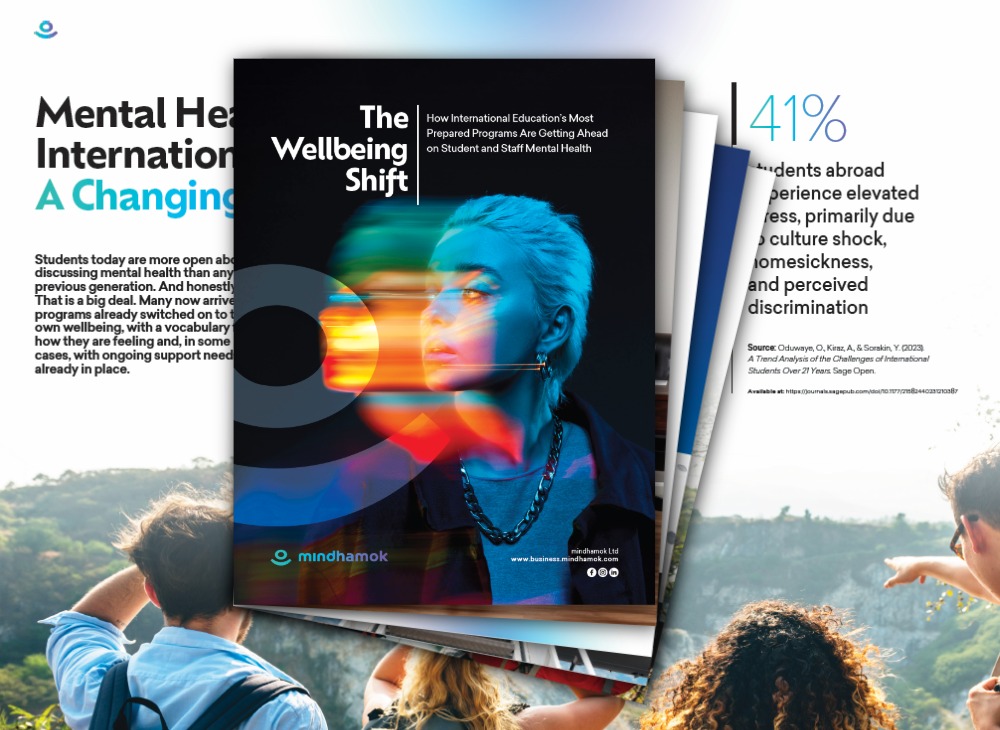
The Wellbeing Shift: A White Paper on Student and Staff Mental Health in International Education
Student mental health in international education has never been more important. Or more complex.
Study abroad programs are seeing more students arrive with pre-existing mental health needs. Staff are being asked to respond to situations that go far beyond their traditional roles. And institutions are facing growing expectations around duty of care that can no longer be met with good intentions alone.
The Wellbeing Shift is mindhamok’s white paper for leaders, faculty and staff working in international education. Drawing on years of direct experience supporting students and staff across study abroad programs, university partnerships and insurance providers, it brings together ten of the most consistent wellbeing themes we see across the sector, and where the right support makes the biggest difference.
Inside you will find practical frameworks, real sector insights and evidence-based guidance across topics including:
These themes sit at the heart of the mindhamok workshop series, our professional development programme built specifically for international education teams. The white paper brings that knowledge together in one place, grounded in the real patterns we see every day across the sector.
Whether you are a study abroad program provider, a university sending students overseas, or an organisation responsible for the welfare of young people abroad, this guide is for you.
The World Health Organization has identified loneliness as a major public health concern among young people, with between 17 and 21% of those aged 13 to 29 reporting feeling lonely despite constant digital connection. For students navigating an unfamiliar country, culture and academic environment, that statistic carries particular weight.
If you work in international education and you want to better understand the wellbeing landscape your students and staff are operating in, this is your starting point.
Neurodiversity and International Education: What Institutions Need to Consider as the Conversation Shifts
In international eduction, this shift has practical implications for study abroad teams, on-site staff and student mental health strategy. Not that long ago, neurodiversity was a word that lived mostly in clinical settings. Assessments. Reports. Meetings that felt formal and slightly intimidating. Conversations that happened quietly, sometimes with a lowered voice. It felt medical. Contained.
Now, it shows up everywhere. On university forms. In workplaces. On social media. In podcasts people listen to on the train. In group chats at 11pm when someone says, “Wait… is this an ADHD thing?” People reference executive functioning in casual conversation. Autism is discussed alongside identity and culture. Families arrive better informed, asking thoughtful questions. This requires a prevention first mindset in response and support. The volume has shifted. But so has the tone.
At mindhamok, we spend a lot of time noticing subtle changes in how people speak about mental health, particularly across international education settings; from pre-departure briefings to on-site student support conversations.
It hasn’t just grown louder. It has become more human.
From Deficit to Description
There was a time when neurodivergence was framed almost entirely through deficit.
What someone could not do
Where they struggled
How they differed from the ‘norm’
The language felt clinical. Sometimes cold. Now, the conversation feels more descriptive. More lived-in, so to speak. We hear people talk about how their brains work. Not just what diagnoses they hold. They talk about needing structure to get through the day. About; how open-plan offices drain them by lunchtime, hyperfocus that means they forget to eat, then crash later, the exhaustion that comes from “holding it together” socially and finally unravelling in private.
There is more nuance. Less whispering. And when someone is living or studying abroad, that nuance really matters. For international education professionals, staff and faculty, this shift in language has practical implications. The way students describe their needs is changing. Intake forms, risk assessments and support pathways need to keep pace. Moving countries stretches identity in ways we often underestimate. It is not just a change of address. It’s new humour, new expectations, new culture & rhythms of conversation. Also it’s learning which silence is awkward and which is respectful. Then, figuring out how things work without always knowing who to ask.
Add cognitive difference into that mix and the experience can intensify in ways that are not always visible from the outside. For program teams, this means that what appears as disengagement, lateness or withdrawal may require a more curious interpretation. Behaviour does not always equal risk. Sometimes it reflects overwhelm.
Living & Studying Abroad Makes Everything Louder
Living abroad amplifies most things. Excitement becomes exhilaration. Homesickness can quietly deepen into loneliness. Independence can feel empowering at 10am and destabilising by 10pm.
We talk a lot about culture shock. But we talk less about how culture shock interacts with the way someone’s brain processes uncertainty, noise, change or ambiguity. For neurodivergent individuals, amplification often shows up in small, very real moments.
Trying to renew a visa in a language you’re still learning, while fluorescent lights hum and the queue grows longer behind you
Navigating a packed underground train where every announcement sounds different from what you’re used to
Living in shared housing where you cannot control the noise in the kitchen at midnight
Replaying a conversation over and over because you’re not sure if that joke landed the way you thought it did
Individually, these moments might seem manageable. Collectively, they can be draining.
None of this means neurodivergent people should not live abroad. Many thrive. Creativity expands. Curiosity deepens. New environments can unlock confidence and independence in unexpected ways. But amplification cuts both ways. And when systems assume one “standard” way of coping, the strain often falls on the individual.
The Role of Culture and Shared Language in Study Abroad Settings
We can’t talk about this shift without acknowledging culture. Social platforms have given people vocabulary. Films and documentaries have widened understanding. Shared stories have made lived experience visible in ways that were rare even ten years ago.
Take the 2026 BAFTA Award winning film ‘I Swear‘. It doesn’t just portray neurodivergence as a list of traits. It shows complexity, frustration and humour in the same breath. Capability alongside overwhelm. It allows audiences to sit with contradiction. If you haven’t seen it, we strongly recommend you watch it, if you are like us, you will simultaneously laugh and cry at certain points whilst feeling the instant shame of finding humour in someone else’s challenge. Cultural references like that matter. They soften stigma. They invite empathy. But culture also accelerates language. And when language spreads quickly, nuance can get lost.
Not; every distracted afternoon is ADHD, every need for quiet is autism, every moment of overwhelm is executive dysfunction.
There is a difference between curiosity and diagnosis. Between relating to a trait and living with a pattern that shapes daily life. Living or studying abroad can blur those distinctions further. When someone is already navigating identity shifts and cultural adaptation, it can be difficult to untangle what is homesickness, what is stress, and what might be something deeper. That is where careful, informed conversations within the international abroad sector become essential.
What We’re Seeing in Real Time
One of the clearest indicators of change is how people ask for support — not only students, but staff as well. We are seeing more therapy requests that reference neurodivergence directly. Often not in clinical terms, but in lived language.
“I think I might have ADHD and I can’t keep up with everything here.” “I’m autistic and shared spaces are overwhelming.” “I feel like I’m masking all day and I’m exhausted.”
That specificity reflects something important. A generation that is more informed. More willing to name what feels difficult. Less inclined to internalise misunderstanding as personal failure. It also places responsibility on organisations and employers to respond thoughtfully.
It reflects rising expectations around informed support. Students increasingly assume that institutions understand neurodiversity as part of their duty of care framework, not as an add-on. Because when someone discloses neurodivergence, the response they receive shapes what happens next.
A calm, informed response builds safety. A rushed or dismissive one reinforces silence.
And when someone is travelling and/or studying overseas, away from familiar support systems, that response carries weight.
Masking, Burnout and the Quiet Middle
Masking comes up often. Not dramatically. Not always with that word. But in description. Smiling through conversations all day. Mirroring tone. Suppressing stimming. Carefully editing yourself in meetings. Maybe lying in bed replaying it all. Interning, working, living, travelling or studying abroad always requires adaptation anyway. You are already adjusting to new cultural norms. Layer masking on top of cultural adaptation and the energy cost increases, burnout does not always look like collapse. Often it is quieter.
Waking up tired even after sleep.
Becoming more irritable.
Withdrawing slightly from social plans.
Feeling like small tasks take disproportionate effort.
For on-site teams and program leaders, these patterns often surface indirectly; through attendance concerns, conflict within shared housing, or repeated low-level distress. Recognising masking and burnout as potential underlying drivers can change the response entirely.
Beyond Awareness
Awareness is a starting point. It is not the endpoint. The sector has moved beyond simply recognising neurodiversity. The question now is how that recognition translates into policy, training and everyday decision-making.
In real life, that might mean:
Communicating expectations clearly rather than assuming they are obvious
Offering structure without rigidity
Allowing flexibility without lowering standards
Recognising that what looks like disengagement might actually be overwhelm
These are subtle shifts. But subtle shifts accumulate. When someone is studying or living abroad, already navigating identity, independence and adaptation, those shifts can make the difference between coping and burning out. That is why we are leaning further into this conversation; 1. Therapy provision that reflects neurodiversity-informed practice. 2. Strengthening our global network of therapists experienced in neurodivergence. and 3. Through workshops that build staff confidence in responding early and proportionately.
Not because neurodiversity is new. But because the context around it has changed.
What This Means for International Education
This shift raises important questions for the sector:
Are pre-departure programs preparing students for sensory and executive functioning challenges abroad?
Do staff feel confident differentiating between cultural adjustment and neurodivergent overwhelm?
Are response pathways proportionate rather than reactive?
Is neurodiversity embedded within wellbeing strategy, or addressed only when crisis emerges?
These are not theoretical questions. They sit at the heart of student experience and institutional responsibility. Institutions that embed neurodiversity-informed practice within their wellbeing strategy are likely to see stronger student outcomes and reduced crisis escalation.
A Wider Cultural Moment
Zooming out, this shift reflects something bigger. There is growing recognition that there is no single “normal” way to think, learn or regulate. Cognitive diversity is part of human diversity. In a world shaped by global mobility and cultural exchange, it makes sense that conversations would expand to include neurodiversity.
Living abroad already challenges assumptions about language, culture and identity. Expanding that lens to include cognitive difference is not adding complexity for the sake of it. It is acknowledging reality. The task now is not simply to acknowledge neurodiversity. It is to integrate understanding quietly and consistently into how we design environments, how we interpret behaviour, how we respond when someone says, “I’m struggling.”
Where This Leaves Us
These shifts rarely happen dramatically. They unfold through language. Through media. Through small interactions that accumulate. But when we look back, the change is undeniable. Neurodiversity is no longer a side note in conversations about working, living and studying abroad. It is part of the landscape. The tone is more open. More layered. Sometimes messy. Often more honest.
There is still learning to do. Still nuance to hold. Still complexity to navigate. But there is also progress. Because when we widen the definition of what is “normal”, we create space.
And when someone is far from home, navigating unfamiliar systems and building a life in a new place, the environments we design either widen that space or narrow it.
Trauma-Informed Practice and the Evolving Duty of Care in Education Abroad
/Trauma-informed practice/ [noun]
An approach to supporting individuals which recognises that behaviour may be shaped by past or present trauma, prioritises psychological safety, and responds with curiosity, consistency and proportionate care rather than judgement or punishment. In education abroad, it underpins how institutions design student mental health support and manage duty of care overseas.
A Shift in How We Understand Student Behaviour
Across education abroad and global mobility programs, I am seeing institutions quietly re-examining what student mental health duty of care overseas really means. Through our work at mindhamok providing counselling and 24/7 mental health support to students studying abroad, a consistent pattern is emerging. Many of the situations referred to us are not purely academic or behavioural concerns. They are trauma responses surfacing in unfamiliar environments.
On paper, a student may be described as disengaged, disruptive or volatile. In reality, we are often seeing a nervous system under strain. When students travel, they lose routine, familiarity and proximity to their usual support networks. Cultural disorientation, academic pressure, language barriers and social isolation can all amplify stress. For students carrying previous trauma or unresolved distress, those stressors can activate protective responses. Avoidance, irritability, conflict or shutdown are not personality flaws. They are signals. From a student wellbeing perspective, that distinction matters. From a risk management perspective in study abroad programs, it matters even more.
Behaviour as an Early Risk Indicator
Historically, behaviour overseas may have been addressed through a conduct lens. Missed classes, withdrawal from excursions or escalating conflict were framed as adjustment problems. Increasingly, institutions are recognising that behaviour can be an early risk indicator.
In overseas settings, stress responses intensify due to:
Loss of routine and predictability
Cultural and language fatigue
Social isolation
Academic performance pressure
Previous trauma resurfacing
The absence of a formal incident does not mean the absence of distress. Some of the highest-risk cases we support began quietly, long before anything met the threshold of a reportable crisis. A trauma-informed approach does not require faculty or staff to diagnose. It requires steadiness and proportionate response. It shifts the internal question from “What is wrong here?” to “What might this student need right now?”
In practice, early misinterpretation often increases escalation risk. Reactive disciplinary responses can compound shame. Staff can feel overwhelmed when behaviour appears unpredictable. Students may retreat further. Managing mental health risk in education abroad increasingly depends on recognising patterns early and responding consistently, rather than waiting for crisis.
Embedding Prevention into Program Design
The programs we see functioning most effectively embed prevention into their design. Mental health support is not an add-on, it is built into how the program operates. That typically includes:
Pre-departure mental health preparation for study abroad
Clear and communicated escalation pathways
Regular, structured wellbeing check-ins
Staff & faculty training in recognising trauma-related distress
24/7 access to confidential in-person counselling or telehealth
When students understand how stress responses may present, they are less alarmed by their own reactions. When staff know exactly how and when to escalate, they are less likely to overreact or hesitate.
Supporting Faculty and Staff Under Pressure
Faculty-led and short-term programs carry particular exposure. Faculty members often become first responders in emotionally charged situations without formal mental health training. In the reflective spaces we facilitate with programme leaders, I regularly hear how isolating that responsibility can feel. Mental health training for study abroad staff is not about turning academics into clinicians. It is about helping them feel steady when students are not. Clear documentation processes, defined thresholds and access to independent clinical consultation create stability for everyone involved.
Why This Matters Now
Post-pandemic, expectations have shifted. Students are arriving overseas with higher baseline anxiety, greater fluency in mental health language and stronger expectations of institutional responsibility. Insurers and regulatory bodies are also paying closer attention to how mental health risk is managed in education abroad. Student mental health overseas is no longer peripheral to programme delivery. It is central to programme viability, student retention and institutional reputation.
Trauma-informed thinking, in this context, becomes less of a clinical philosophy and more of an operational foundation. It shapes how reporting pathways work across time zones, how confidential support is accessed by students hesitant to disclose formally, and how institutions learn from near-miss incidents, not only crises.
From Crisis Response to Prevention-First Duty of Care
At mindhamok, we see this daily. Our role is to support students directly through counselling and 24/7 mental health support abroad, while also working alongside staff and faculty to build steadier systems. Prevention-first support strengthens student wellbeing in global mobility programmes and reduces avoidable escalation. When trauma-informed thinking is embedded early, fewer situations spiral. Students ask for help sooner. Staff feel less exposed. Institutions carry less unmanaged risk.
The question is no longer whether trauma-related distress will surface in international education. It is whether programmes are designed to recognise it early and respond well.
That is where prevention becomes not just a wellbeing strategy, but a duty of care strategy.
Supporting Student Mental Health Abroad: Moving from Crisis Response to Prevention
In 2026, Student mental health is no longer a peripheral issue in education abroad, it sits right at the centre of student safety, duty of care, program quality and institutional risk. Most people working in international education today will recognise the shift. More students are travelling with existing mental health needs. More incidents are surfacing while students are overseas. And staff, whether they are education abroad advisors, faculty leaders, on-site teams, or insurance partners, are being asked to respond with confidence in increasingly complex situations.
Last year The Forum on Education Abroad’s produced the document ‘Guidelines for Supporting Student Mental Health and Wellness on Education Abroad Programs (2025)‘, this work reflect this reality clearly. The document offers a shared framework for how institutions, program providers, and partners can think about mental health across the full student journey: before departure, during the program, and after return. What stands out is not just what the guidelines recommend, but how they frame responsibility. Supporting student mental health abroad is not the job of one office, one provider, or one intervention. It is a shared, collaborative effort that works best when systems are designed upstream, not improvised in moments of crisis.
Mental Health Abroad Is a System Issue, Not an Individual One
Mental health crises are consistently reported as one of the most disruptive critical incidents in education abroad, often leading to early withdrawal or program termination. Yet many organisations still rely heavily on reactive approaches, stepping in only once a situation has escalated. The Forum guidelines encourage a different mindset: one that recognises mental health support as an integral part of program design, staffing, training, and partner selection. This includes:
Clear policies and expectations around mental health support
Transparent communication with students about what support is and is not available abroad
Collaboration with counselling services, insurance providers, and assistance companies
Training staff and faculty to recognise early warning signs
Normalising mental health conversations to reduce stigma
These principles align closely with a prevention-first model, where the goal is not to eliminate risk (an impossible task), but to reduce the likelihood and severity of crises by building resilience, awareness, and access to care early.
Why Prevention Matters for Students, Staff, and Institutions
A prevention-focused approach benefits more than just students.
For staff and faculty, it reduces the emotional and professional burden of becoming de facto crisis managers. Many education abroad professionals report feeling underprepared, overstretched, and anxious about making the “wrong” call when a student is in distress. Structured support systems, training, and clear escalation pathways help staff focus on their actual roles while knowing support is in place.
For institutions and program providers, prevention supports:
Student retention and program completion
Reduced emergency costs and disruption
Stronger duty of care frameworks
Greater confidence from parents and partners
More consistent student experiences across destinations
For insurance and assistance companies, prevention complements emergency response by reducing avoidable escalations and supporting appropriate use of services, including telehealth and local care pathways.
No Single Organisation Can Do This Alone
One of the strengths of the Forum guidelines is their emphasis on collaboration and transparency. Effective mental health support abroad depends on strong partnerships across the ecosystem.
Many organisations already play a critical role in this space:
NAFSA provides research, training, and best practice guidance for international educators
International assistance providers offer 24/7 emergency response, telehealth, and evacuation services
Insurance providers enable access to mental health care across borders
Campus counselling services prepare students before departure and support reintegration
Each of these contributes something essential. The challenge, and opportunity, lies in how well these pieces connect.
Bridging the Gaps Students Fall Through
Despite best intentions, gaps still exist. Students may not disclose mental health concerns before departure. Support options abroad may differ significantly from home. Cultural stigma, language barriers, and access issues can delay care. Staff may hesitate to escalate concerns until a situation becomes urgent.
This is where layered support models are proving effective. Combining:
Pre-departure mental health education
Clear, accessible pathways to support while abroad
24/7 emotional support options
Short-term counselling or telehealth
Staff training and reflective support spaces
creates a safety net that catches issues earlier and supports everyone involved.
Where mindhamok Fits In
mindhamok was built specifically to support students and staff navigating the emotional realities of studying abroad. We do not replace campus counselling services, insurance providers, or assistance companies. We sit alongside them. Our work focuses on prevention, early intervention, and staff support, helping organisations embed mental health and wellbeing into their education abroad programs rather than treating it as an add-on.
That includes:
Pre-departure preparation that normalises mental health conversations
24/7 emotional support for students abroad
Access to experienced counsellors who understand international education contexts
Training and reflective spaces for staff and faculty
Support during and after critical incidents
Most importantly, we work collaboratively, aligning with existing partners and policies so that students experience support as joined-up rather than fragmented.
Turning Guidelines into Practice
The Forum’s guidelines provide a valuable roadmap. Turning them into lived practice requires time, coordination, and the right partners. For education abroad professionals, program providers, and insurance and assistance organisations, the question is no longer whether student mental health abroad needs attention. It is how to build systems that are sustainable, ethical, and genuinely supportive for students and staff alike.
If you are reviewing your mental health and wellbeing approach in light of the Forum guidelines, or thinking about how to move from reactive crisis response to a more prevention-focused model, we are always happy to share what we are seeing across the sector and explore how our solutions might support your existing framework.
You can learn more about mindhamok’s approach to supporting student mental health abroad at www.mindhamok.com, or reach outto start a conversation.